James Lee had apprenticed at the Chelsea Physic Garden with botanist and superb botanical artist, Philip Miller F.R.S. (1691-1771). Lee also corresponded with the great Swedish naturalist Carl Linnaeus (1707-1778). Linnaeus devised the Latin individual descriptive (taxonomic) double-name format for all species of nature (which avoids confusion from the dual, and often triple, use of common names.) After working in the grand gardens of Syon House, Lee became gardener to Archibald Campbell, 3rd Duke of Argyll, who imported exotic plants and trees for his estate at Whitton Park, renowned for its unusual botanical specimens from around the world.
From an early age, Henry C. Andrews was passionate about illustrating flowers. In 1794 he began publication of illustrations of the genus Erica... Coloured Engravings of Heaths: the Drawings taken from Living Plants Only. with the appropriate specific character, full description, native place of growth, and time of flowering of each, in Latin and English... according to the Linnaean System. The whole executed by H.C. Andrews, botanical painter, engraver &c, published by the author, No. 5 Knightsbridge, with accompanying descriptive letterpress pages by the curator of the Chelsea Botanic Gardens.
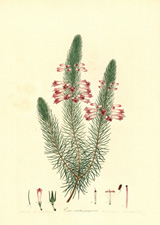
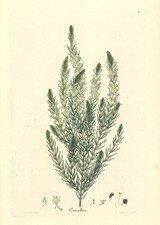
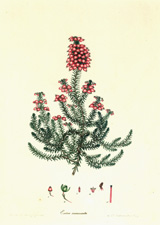
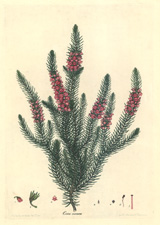
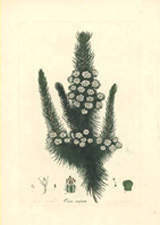
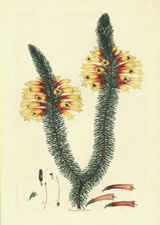
H.C. Andrews drew and then engraved fine copperplate etchings of Ericas or Heath flowers with enlarged dissections of their parts at the base of each, - which always makes botanical illustrations more interesting. Henry then printed from these copperplates onto hand-laid paper (many, unusually printed with green ink), and hand-coloured each print with watercolours. He published them in London, a few at a time to make them more affordable, and triggered what was dubbed at the time "Erica mania" (with reference to the previous century's "Tulip mania", when worldwide collectors paid enormous amount for the rarest tulip species.) The demand for the exquisite etchings of Ericas by Henry Andrews, not only increased the value of the actual Erica specimens imported from overseas, it also established Henry Cranke Andrews' reputation as a fine botanical artist. (One of the Erica etchings was published uncoloured, and shows even more clearly the finesse of Andrews's etching.)
Between 1797 and 1814 Andrews also contributed some beautiful finely-engraved and hand-coloured botanical specimens for The Botanist's Repository - including Australian flowers which were some of the more unfamiliar specimens then received in Britain.
In 1801 Henry Andrews married Ann Kennedy, the daughter of John Kennedy, the nurseryman who had given him so much assistance over the years. With a gifted hand and a meticulous eye for detail, Henry Andrews devoted his life to painting flowers, and excelled as a botanical artist, engraver, etcher, and teacher. Taught by his father to draw and etch from nature, Henry Andrews (junior) (1808-1868), became a historical artist and recorded buildings, landscapes and genre scenes. He lived with his widowed mother Ann Andrews - and his wife Teresa, when they married.
There's a stunning selection under /Antique-Prints/Botany-Flowers,Fruit,Herbs/Botanicals-1597-1805.aspx?page=4